


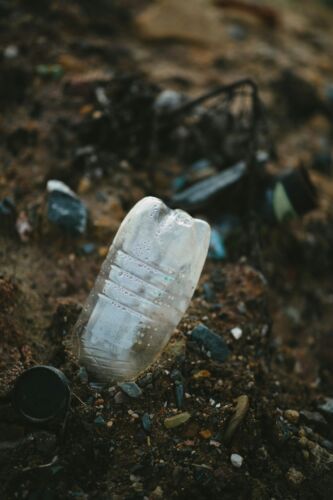
The bottle is sold as purity. The lab is less romantic. Researchers at Columbia and Rutgers, writing in the Proceedings of the National Academy of Sciences, counted about 240,000 detectable plastic particles in a typical liter of bottled water, most of them nanoplastics. That is not a reason to panic-sip. It is a reason to stop treating single-use plastic as a health product.
Earlier bottled-water studies mostly saw microplastics, the larger fragments. The new imaging method, stimulated Raman scattering microscopy, looked smaller — down toward 100 nanometers — and chemically identified common polymers. About 90 percent of the particles were nanoplastics. Counts in samples ranged on the order of 110,000 to 400,000 per liter. PET from the bottle and polyamide, a nylon often used in filters, showed up. Most of the nanoparticles did not even match the seven plastics the team targeted. The water is not empty. We just could not see the inventory.
Are nanoplastics in bottled water a health risk?
Direct human toxicology is still thin. Smaller particles are more able, in principle, to cross barriers that a visible shard cannot. NIH’s summary of the work was careful: the method helps us see a poorly understood class of particles. It does not hand you a disease name. Absence of a finished risk assessment is not the same as a purity medal. It means the product was marketed ahead of the microscope.
Is tap water better than bottled?
Tap water is not automatically particle-free. It is usually less of a PET flask. If your utility water meets standards and you like the taste, a glass or stainless bottle you wash is the less plastic habit. If your tap is compromised, a filter certified for the actual problem — lead, PFAS, microbes — is a better buy than a case of branded “alpine” water in disposable polymer. Filter the tap. Do not outsource thirst to a vending machine.
How can you drink less plastic?
- Use tap water in glass or stainless when the tap is trustworthy.
- Do not store water in a hot car in a thin plastic bottle.
- If you need bottled water in an emergency, use it. Daily life is not an emergency.
- Skip the plastic-packaged “fitness” water that exists to sell a lifestyle.
The Columbia and Rutgers team was not counting beach litter. Stimulated Raman scattering microscopy chemically fingerprinted particles down toward 100 nanometers. PET from the bottle and nylon from filters were among the matches. Most nanoparticles did not even match the seven target plastics, which means the inventory is still incomplete. Heat, time, and squeezing a bottle are not proven to be the whole story. They are still a poor storage plan. Do not bake water in a car.
Should you stop drinking bottled water?
As a daily habit, yes, if your tap is trustworthy or can be filtered for the actual problem it has. Bottled water remains useful in outages, travel, and boil-water notices. It is a tool. It is a terrible identity. Glass and stainless you wash beat a polymer that sheds into the thing you meant to purify. If you dislike tap taste, a carbon filter aimed at chlorine is a cheaper personality than a mountain label.
We do not yet have a finished human toxicology chapter for nanoplastics in drinking water. We do have a product that was sold as emptiness and turned out to be a particle suspension. Drink water. Stop paying a premium for the bottle that manufactured some of the particles.
Hydration is mandatory. The disposable bottle was always optional. The particle count is just the receipt.
Single-use plastic water is a logistics product that borrowed a health vocabulary. The PNAS particle counts are a laboratory receipt for that swap. Refill a bottle you own. Filter the tap for the contaminant you actually have. Keep emergency cases for emergencies. Everyday thirst does not require a polymer factory.